
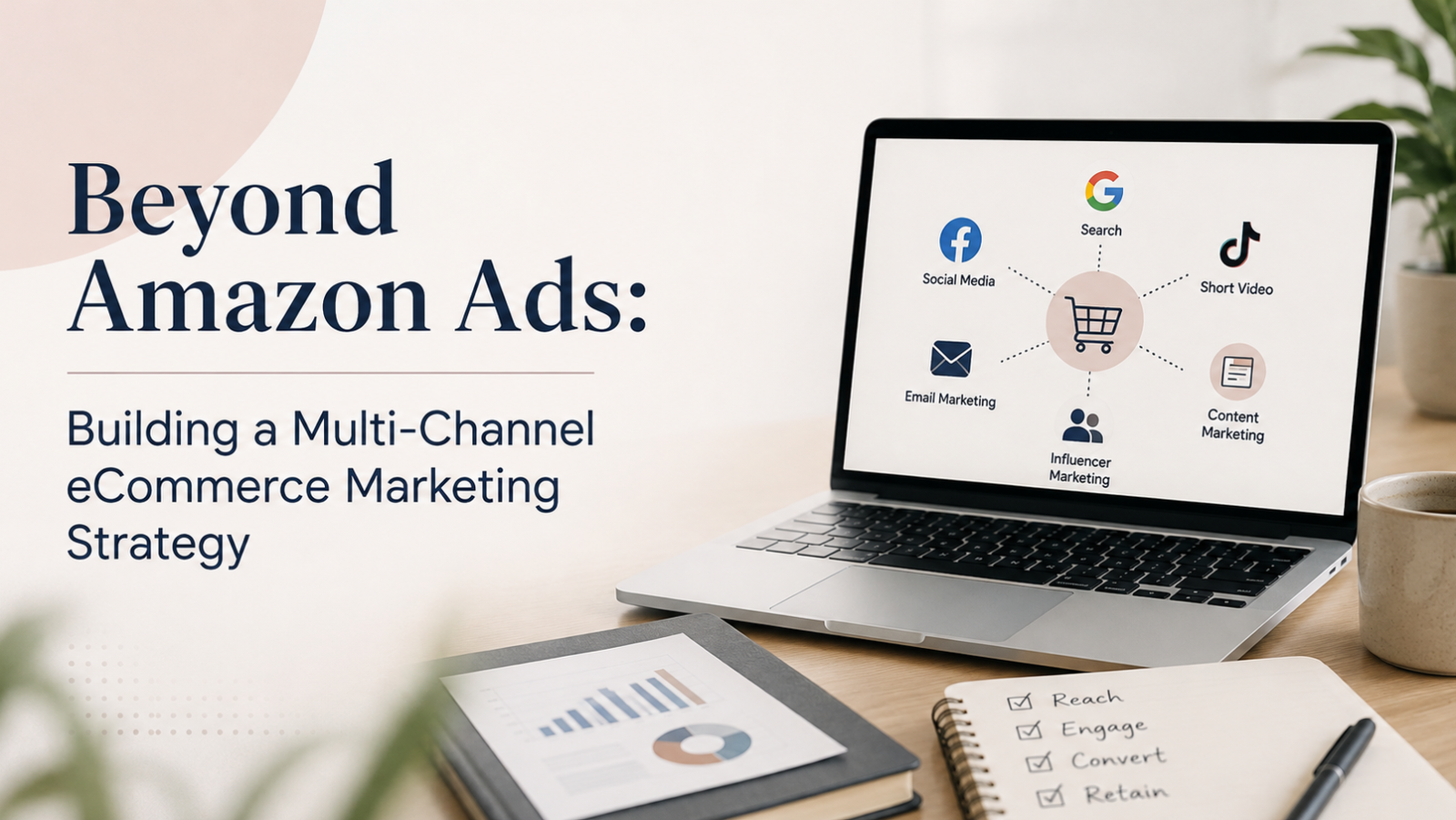
For years, Amazon advertising offered sellers a predictable path to growth: identify high-intent keywords, increase bids, improve listings, and capture demand where millions of shoppers were already searching. But as more brands compete for the same visibility, the economics of relying solely on Amazon Ads are changing.
Higher CPCs, increasing ad saturation, shifting organic ranking dynamics, and limited ownership of customer relationships are forcing sellers to rethink how they generate demand. Amazon remains one of the most valuable conversion channels, but it is increasingly becoming one part of a broader eCommerce acquisition strategy rather than the only growth engine.
The shift is not about moving away from Amazon. It is about understanding where customers discover products, how they evaluate purchase decisions, and which channels allow brands to build lasting customer relationships. Social commerce, creator marketing, paid search, DTC channels, and other marketplaces are becoming important demand sources that complement Amazon’s ability to capture purchase intent.
For sellers, the challenge is no longer whether to advertise on Amazon. It is how to build a multi-channel eCommerce marketing strategy where each channel has a defined role: creating demand, capturing high-intent shoppers, and strengthening long-term brand value.
Key Factors Behind Amazon Sellers’ Shift Beyond Amazon Ads
#1 Rising CPCs Across Amazon Ad Auctions
Amazon CPC pressure increases as more sellers and brands bid on the same high-intent, high-converting search terms and limited Top of Search placements. Placement bid adjustments and Dynamic bids can further increase what advertisers pay for valuable impressions. As auction competition intensifies, maintaining impression share on commercially important keywords drives higher CPCs, encouraging sellers to shift part of their acquisition spend to channels outside Amazon.
#2 Ad Saturation and Diminishing Incremental Returns
Sponsored Products, Sponsored Brands, and Sponsored Display now occupy placements across search results and competitor product detail pages. The FTC alleged in its monopoly complaint that Amazon degraded the customer experience “by replacing relevant, organic search results with paid advertisements, and deliberately increasing junk ads that worsen search quality.”
Where ad load expands faster than qualified demand, incremental spend increasingly converts shoppers who would have reached the ASIN organically. Rising TACoS alongside stable attributed ROAS is the operating signal: attributed sales track the budget, total sales do not, and the extra spend defends existing visibility rather than generating new orders.
#3 Ranking Volatility Under AI-Driven Retrieval
Amazon uses advanced AI-backend systems such as COSMO to infer shopper intent and product relationships. Relevance extends beyond exact-match keyword coverage into attributes, use cases, and contextual intent, which means organic position can move without any change to listing copy, price, or review velocity.
The advertising consequence is direct: sellers who lose organic ground compensate with paid placements, so ad dependence rises just as ad efficiency falls. External marketing channels reduce this dependence by giving sellers traffic and demand sources that are not tied directly to Amazon’s organic ranking changes.
#4 Product Discovery Is Moving Beyond Marketplace Search
More shoppers now discover and evaluate products through social media, creator content, search engines, video platforms, and online communities before visiting Amazon. TikTok, Instagram, YouTube, Google, and influencer content increasingly shape product awareness and consideration earlier in the purchase journey.
This shifts part of the marketing opportunity outside Amazon, where sellers can influence demand before shoppers compare ASINs or encounter Sponsored Products.
#5 Platform Risk Concentrated in One Marketplace
Commercial risk increases when customer acquisition, product visibility, and sales are concentrated on Amazon alone. Account deactivation, listing suppression, loss of Featured Offer eligibility, or policy-related restrictions can immediately interrupt both paid and organic revenue. Expanding into D2C, social commerce, search, and other marketplaces gives sellers alternative acquisition and conversion paths, reducing the share of revenue exposed to any single Amazon-specific disruption.
#6 Limited Ownership of First-Party Customer Data and Audiences
Amazon gives sellers access to order and performance data, but customer relationships remain largely within the Amazon ecosystem. Brand-registered sellers can use tools such as Brand Tailored Promotions to reach repeat, lapsed, and high-intent audiences, but Amazon manages those audiences rather than giving sellers direct access to them through their own CRM or marketing ecosystem.
This limits how independently brands can build retention programs and measure customer lifetime value across channels. D2C storefronts, email, SMS, and other owned channels give sellers greater control over first-party audiences and repeat-purchase marketing.
#7 Amazon Rewards Brands for Driving External Traffic
The six factors above push sellers toward external demand. Amazon’s programs determine whether that move pays off. Through the Brand Referral Bonus, eligible sellers earn a bonus averaging approximately 10% of qualifying sales generated through tracked external traffic, and Amazon Attribution lets them measure traffic from search, social, email, and other sources. These programs help sellers evaluate external marketing performance while still using Amazon as a conversion channel.
| The Right Way to Approach Multi-Channel eCommerce Marketing Strategy
Expanding beyond Amazon does not mean simply moving budget to another platform. Each channel introduces different acquisition costs, content requirements, operational workflows, and measurement challenges. Social commerce, search, creator marketing, and D2C channels require dedicated strategies, not a direct replacement for Amazon Ads. A multi-channel eCommerce strategy requires defining each channel’s role: which channels create demand, which capture purchase intent, and which build direct customer relationships. The goal is a balanced acquisition model where Amazon remains one conversion channel among multiple growth sources. |
The Framework: Building a Multi-Channel eCommerce Marketing Strategy Beyond Amazon Ads
1. Establish Unit Economics Before Expanding Channels
Before investing in additional channels, sellers need visibility into true SKU-level profitability. Referral fees, fulfillment costs, storage, returns, discounts, and advertising expenses determine whether a product has enough margin to support customer acquisition beyond Amazon. This prevents brands from scaling products that generate sales volume but limited contribution margin.
2. Expand Channels Based on Customer Intent
Channel selection should align with how customers discover, evaluate, and purchase products within a category. Creator-led channels can support products where visual discovery influences consideration, paid search can capture customers actively researching solutions, and alternative marketplaces can extend reach among shoppers with existing purchase intent. Testing channels with defined budgets, evaluation periods, and success metrics helps sellers identify where incremental growth opportunities exist before increasing investment.
3. Build the Owned Customer Layer
A DTC storefront, email database, SMS audience, and other first-party assets give sellers greater control over customer retention and lifecycle marketing. Even when Amazon remains the primary sales channel, owned audiences support product launches, repeat purchases, customer engagement, and long-term brand building beyond marketplace constraints.
4. Measure External Demand Generation
Connect external campaigns across search, social, creator marketing, and email to measurable Amazon outcomes through tools such as Amazon Attribution and Brand Referral Bonus. This lets sellers identify which channels drive Amazon sales, evaluate acquisition efficiency, and make informed decisions about where additional marketing investment can generate incremental demand.
5. Rebuild Measurement for Multi-Channel Performance
Once customers interact with multiple channels, last-click attribution provides an incomplete view of marketing performance. Sellers should evaluate channels using broader metrics such as contribution margin, TACoS, new-to-brand customers, repeat purchase behavior, and SKU-level profitability. Incrementality testing can further distinguish between channels that create new demand and those that capture existing demand.
6. Align Operations With Channel Expansion
Each additional channel introduces new requirements across catalog management, content formats, pricing, inventory allocation, fulfillment, and customer support. A centralized product information system and synchronized inventory processes help sellers maintain consistency across Amazon, DTC stores, social commerce, and other marketplaces while reducing operational complexity.
7. Reposition Amazon Ads as Demand Capture
As sellers develop additional demand sources, Amazon Ads can focus on where marketplace advertising performs best: capturing high-intent shoppers, defending branded search terms, protecting product detail pages, and converting customers already close to purchase. This lets Amazon Ads function as a demand-capture channel within a broader acquisition strategy, while other channels contribute to brand discovery and demand creation.
8. Decide What to Build In-House and What to Outsource
Expanding beyond Amazon Ads requires expertise across multiple advertising ecosystems, including paid search, social advertising, creator campaigns, and marketplace media. Sellers should evaluate whether their internal teams have the skills, bandwidth, and analytical capabilities to manage cross-channel campaigns effectively. Outsourcing to Amazon marketing services can provide channel expertise, campaign optimization, and performance insights without requiring brands to build every capability internally.
The Next Steps: What Sellers Should Evaluate Before Expanding Their Marketing Strategy to Multi-Channel
Amazon sellers need to evaluate where additional channels can create incremental demand, improve customer acquisition efficiency, and support long-term brand growth.
Before expanding, sellers should assess:
- Which channels align with how customers discover and evaluate products in their category? Prioritize channels where the target audience already shows purchase intent or engages with relevant content.
- Do product margins support the cost of acquiring customers through a new channel? Evaluate contribution margin, advertising costs, fulfillment requirements, and expected lifetime value before scaling investment.
- Can the business build measurable customer relationships beyond Amazon? Identify opportunities to develop first-party audiences through DTC, email, SMS, and other owned channels.
- Does the team have the expertise and resources to manage multi-channel advertising effectively? Determine which capabilities can be developed internally and where specialized support, such as Amazon marketing services or channel-specific expertise, may be required.
- How will performance be measured across channels? Define metrics beyond immediate sales, including contribution margin, incremental demand, customer acquisition efficiency, and repeat purchase behavior.
The next step for sellers is not simply expanding to more platforms. It is building a channel strategy where each platform has a defined role: creating demand, capturing purchase intent, or strengthening customer ownership. This approach lets Amazon remain a valuable conversion channel while additional marketing channels drive broader eCommerce growth.
Turning Channel Diversification Into a Growth Advantage
Channel diversification should not be viewed as simply adding more platforms — it should be about building a more resilient growth system. Amazon can remain a powerful conversion engine, but brands should complement it with channels that strengthen discovery, customer relationships, and long-term brand equity.
A diversified approach allows brands to capture demand more effectively while reducing the risks of rising advertising costs, increasing competition, and limited customer ownership. Sellers who take this approach will be better positioned to adapt, scale, and compete as eCommerce continues to evolve.
